
The Netherlands is going through one of the most turbulent policy periods in decades — a housing shortage, a nitrogen crisis squeezing rural land use, and a wealth tax system the courts themselves have ruled unworkable. None of this forces anyone out of the country in a legal sense: Dutch citizens remain completely free to live wherever they choose. But the combination of tax pressure, cost of living and policy uncertainty is a real and growing push factor, and it’s showing up directly in our enquiries here in Marbella. Here is what is actually happening, what it means for your finances, and why so many Dutch homeowners are choosing to sell in Holland and buy on the Costa del Sol.

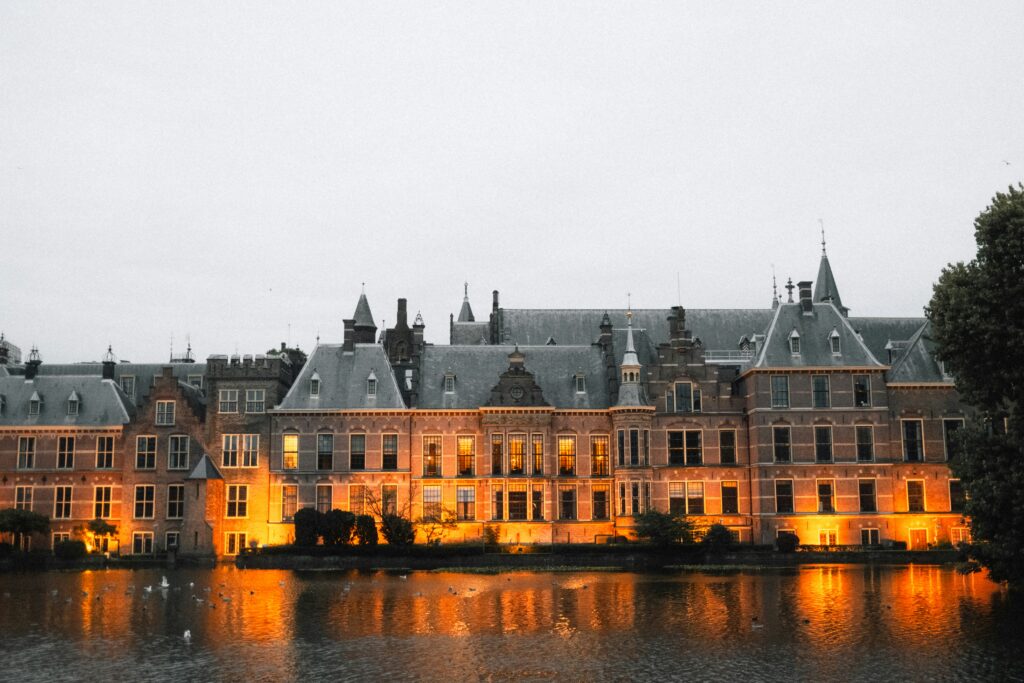
The Binnenhof in The Hague, seat of the Dutch government and parliament.
In this article
- What’s actually happening in the Netherlands
- The main obstacles the Dutch government has imposed on residents
- Tax implications: selling in the Netherlands
- Tax implications: buying in Spain
- The benefits of selling in Holland and buying in Spain
- Marbella and Costa del Sol, by the numbers
- Thinking about making the move?
What’s actually happening in the Netherlands
Three separate crises are converging at once, and each one touches Dutch homeowners differently.
A structural housing shortage. The Netherlands is short an estimated 410,000 homes — roughly 4.8% of its entire housing stock. Only about 69,200 homes were completed in 2025, well under the government’s own 100,000-a-year target, held back by nitrogen permitting rules, construction costs and municipal approval processes that routinely take 8–12 years. The 2024 Affordable Rent Act, meant to cap rents on regulated homes, had the opposite effect on supply: landlords sold roughly 65,000 rental homes in 2025 while buying only 27,000, pulling private rental stock out of the market. Unregulated rents rose 7.3% year-on-year in early 2026, and in Amsterdam now average over €28/m².
The nitrogen crisis. Since a 2019 court ruling struck down the Netherlands’ nitrogen permitting framework, farmers in particular have faced land-use restrictions, forced-buyout schemes near protected nature areas, and years of legal and political conflict over compensation. It has become one of the most polarising domestic issues in the country and continues to constrain rural development and construction permitting alike.
An overhauled wealth tax. The Box 3 system, which taxed savings and investments (including second homes) on a notional, assumed return rather than actual gains, was ruled unlawful by the Dutch Supreme Court. The new coalition (D66, VVD, CDA) has agreed to scrap the annual levy on unrealised gains and move to taxing actual, realised returns instead — but not until 2028, leaving several more years of transitional uncertainty for anyone holding investment property, shares or savings above the exempt threshold.
The main obstacles the Dutch government has imposed on residents
None of these amount to a legal barrier on where someone can live — as an EU citizen, a Dutch national can move to Spain (or anywhere else in the EU/EEA) freely, with no visa or residency permit required. The obstacles are financial and administrative rather than a “ban,” but they are real:
- Exit tax on substantial shareholdings (aanmerkelijk belang). Anyone holding 5% or more of a Dutch company (a “BV” or “NV”) who emigrates faces a conserverende aanslag — a tax assessment on the unrealised gain in those shares, at Box 2 rates of 24.5% up to €67,000 and 33% above that. Deferral is interest-free within the EU/EEA, but becomes far less attractive outside it.
- Loss of the 30% ruling. This expat tax break (a tax-free allowance of up to 30% of salary) ends immediately on leaving Dutch employment, with no partial credit for time already spent under it.
- Higher transfer tax on second homes and investment property. As of 2026, buying a home in the Netherlands that isn’t your primary residence — including buy-to-let and holiday homes — is taxed at 8% real estate transfer tax (overdrachtsbelasting), versus 2% for owner-occupiers, making it markedly more expensive to keep or acquire Dutch property you don’t live in full-time.
- Ongoing Box 3 uncertainty. Until the 2028 reform takes full effect, anyone with savings, investments or a second home above the exemption threshold remains subject to the current notional-yield system, which has already required multiple legislative patches after being found unlawful.
Tax implications: selling in the Netherlands
The good news for anyone selling their Dutch home: there is no capital gains tax on the sale of your primary residence (eigen woning) in the Netherlands. Any profit from selling the home you actually live in is currently untaxed. A second home or investment property is a different story — it falls under Box 3, taxed on a deemed return on its value (currently around 36% tax on an assumed yield) until the 2028 shift to taxing actual gains takes effect.
A new Spain–Netherlands double tax treaty was approved for signature by Spain’s Council of Ministers in March 2026, though it is not yet ratified. Its most significant change: it gives the “source” country (where a property sits) the right to tax capital gains from selling shares in real-estate-heavy companies, closing a previous loophole. Full details on pensions and dividends are still being finalised — anyone with cross-border holdings should get current advice before relying on treaty terms that haven’t yet entered into force.
Tax implications: buying in Spain
As EU citizens, Dutch nationals need no visa to live in Spain — the “Golden Visa” route (property-linked residency) was abolished in April 2025 for non-EU investors, but this was never relevant to Dutch buyers in the first place, since free movement already applies. Registering as a resident simply means obtaining an NIE (foreigner ID number) and registering with the local padrón — a straightforward administrative process, not an immigration hurdle.
Where buyers do need to budget carefully is purchase taxes and fees, which typically add 10–15% on top of the price:
| Cost item | Andalucía / Costa del Sol |
|---|---|
| ITP transfer tax (resale property) | 7% flat rate |
| IVA (VAT, new-build property) | 10% |
| AJD stamp duty (new-build, in addition to IVA) | ~1.2% |
| Notary fees | 0.5–1% |
| Land registry | 0.3–0.5% |
| Independent legal fees | 1–1.5% (min. approx. €1,500) |
Example: a €400,000 resale villa in Andalucía carries roughly €33,000 in total taxes and costs (about 8.3% on top of the purchase price) — well worth budgeting for from day one.
The benefits of selling in Holland and buying in Spain
- No capital gains tax to release equity. Selling a Dutch primary residence is untaxed, meaning the full equity built up over years of Dutch price growth converts directly into purchasing power in Spain.
- Meaningfully lower cost of living alongside a warmer, more outdoor-oriented lifestyle — consistently the top-cited motivation among Dutch buyers on the Costa del Sol, ahead of investment returns.
- An established Dutch community across the Costa del Sol and Costa Blanca, with Dutch-speaking services, schools and social networks already in place, easing the transition considerably.
- Genuine capital appreciation. Prime Marbella property values rose 8.1% in 2025 — more than double the global luxury property average of 3.2% — making this a wealth-preservation move as much as a lifestyle one.
- No exit barrier for most buyers. Unless you hold a substantial company shareholding, there is no Dutch exit tax on the move itself — the obstacles above mainly affect entrepreneurs and investors with Box 2/Box 3 exposure, not the average homeowner.
Marbella and Costa del Sol, by the numbers
| Metric | Figure |
|---|---|
| Dutch & Belgian share of Malaga province international purchases | Up to 15% |
| Dutch share of all foreign property purchases nationally in Spain | 6.77% (2nd after the UK) |
| Prime Marbella price growth, 2025 | +8.1% |
| Average price, Marbella | €4,424/m² |
| Typical Dutch buyer budget (apartment/townhouse) | €300,000–€800,000 |
| Typical Dutch buyer budget (villa) | €1.5m+ |
| Favoured areas | Estepona, Marbella East, Manilva, Mijas |
Dutch buyers are also described by agents across the coast as decisive, well-researched and largely cash buyers — a profile that tends to move quickly once a decision is made.
Thinking about making the move?
Whether you’re weighing up the tax and timing of a Dutch sale, or ready to start viewing property on the Costa del Sol, our team at Nicolas Estates works with Dutch buyers through every stage of the process — from understanding the numbers above to finding the right home in Marbella, Estepona or Benahavís. Get in touch with us to talk through your options.
This article is for general information only and does not constitute tax or legal advice. Dutch and Spanish tax rules are subject to change and should be confirmed with a qualified advisor before making a decision.